

The Oregon Coast Clam Chowder Challenge
The Oregon Coast is one of the great chowder stretches in the country. Working harbors, fresh Dungeness, sea air you can practically chew — it felt wrong not to rank them. Over four days and four different stops along the coast, I put the local bowls to the test so you don't have to guess. Scored on a five-clam scale across Flavor, Customer Service, and Best Use of the Clam.
The broth leaned lighter than I'd hoped — almost brothier than creamy, which is a real sin in the chowder world. There was flavor there in theory, just a little lost in translation. Not bad, not bold. The kind of chowder that's fine when you're hungry but doesn't stick with you when you leave.
Here's the thing — Jadin at the bar was the absolute highlight of the stop. She made me feel like a regular from the moment I sat down. Warm, attentive, genuinely fun to talk to. If customer service were the only clam category, this would've been a perfect five without hesitation. This is the kind of personality that makes you stay for another bowl, even when the bowl doesn't quite deserve it.
Blink and you might miss them. The clams were small enough that they almost felt like a rumor — present in the bowl, but barely announcing themselves in either flavor or texture. You had to take the menu's word that they were actually in there. More clam presence, please.
This is not your grandma's clam chowder — and that's okay. There's something in the miso butter that transforms a familiar bowl into something genuinely exciting. A warm, slightly savory, umami-forward depth you can't quite name but absolutely want more of. The flavor is bold, creative, and confident. This is the chowder you'd order again just to understand what you're tasting.
The kitchen is clearly where the passion lives. The front of house? Less so. The host greeted me with the energy of someone who had already mentally clocked out — seating me felt more like a task than a welcome. In a coastal town built on tourism, the basics matter. The food makes up for it, but barely.
Manila Clams were the right call — briny, flavorful, and they held up beautifully in that miso broth. The only issue: I ordered a bowl and received something closer to a generous cup. The clams were good. There just weren't quite enough of them to crown this the winner.
This might be the most technically correct chowder on the list. Thick. Creamy. Well-seasoned. A proper potato-to-clam ratio that doesn't apologize for what it is. I grabbed this one to-go — right after breakfast, not ideal timing for a bowl of cream and potatoes — and even at half hunger, it was legitimately great. No fusion, no gimmicks. Just Newport doing Newport.
I have to talk about the bread bowl. When I asked if I should add one to the to-go order, my server paused, looked at me, and offered: "...ahhh, if you like a lot of carbs." They had just opened. The coffee was still brewing. I wasn't asking for a wellness consultation. I got the bread bowl anyway. It was perfect. The chowder didn't need the commentary.
A solid, honest amount of clam in every spoonful. Thick enough that they didn't get lost in the broth. This is what you show someone when you're trying to explain what chowder is supposed to be. The clam is a main character here, not a supporting player.
This one hit different. Creamy and rich, with just enough cheese to feel genuinely indulgent without tipping into heavy. The potatoes were hearty and well-incorporated — a supporting role, not filler. And the clams: fresh, vibrant, alive in a way that makes you realize what you've been missing everywhere else. You can taste the ocean in it. You can taste that it was sourced this morning.
It's a pattern I noticed across the Oregon Coast: tourist towns that somehow forget the tourists are the whole business. Service was adequate — nothing more. For a place where the owner is heading to the docks at sunrise to source the day's menu, you'd hope the front of house would show up with even half that kind of dedication. The gap between kitchen and floor is real.
"Ocean to fork" isn't a tagline at Luna Sea — it's the actual operating model. The owner heads to the docks every single morning to source what goes on the menu that day. The clams in this bowl make the case for exactly why that matters: fresh, substantial, present in every bite. When the main ingredient is this good, everything else just has to stay out of the way — and it does.
Found a bowl worth pulling over for? Send it my way. Every submission goes straight to my inbox — I'll check it out and if it makes the cut, it earns a full troy's.eats review.

The San Diego Italian Dining Series
San Diego's Italian scene runs deeper than most people realize — from the neighborhood trattorias of Little Italy to Sicilian kitchens in North Park sourcing directly from the farmers market. I've been eating my way through the best of it for years. This series captures the ones worth driving for, ranked on a five-canoli scale across Flavor, Customer Service, and Best Use of Italian Ingredients.
The menu at Vinarius reads like a love letter to Italian tradition — Pappardelle al Ragù e Funghi, Salmone al Vino, pastas that feel like they belong in a family kitchen in Bologna. But on this visit I ordered the tenderloin, and I need to talk about it. Lightly breaded in a way that added something real — texture, a barely-there crunch that wasn't quite a crust and wasn't quite a sear, but was exactly right. Perfectly cooked, not just technically but instinctively, the way food is when someone actually cares what ends up on your plate. And if you leave without the cannoli, you've made a serious error. The authentic kind — crispy shell, proper filling, none of the shortcuts. This is what a cannoli is supposed to be, and most of San Diego has forgotten.
Giuseppe is the owner and he is the room. Warm, sincere, and genuinely present in a way you rarely see from someone running a dining room — not performing hospitality, just actually being hospitable. You feel like family from the first moment you walk in, and that isn't an accident. His daughter works the front of house sometimes, and she carries the same quality. The whole team does. Friendly without being performative, attentive without hovering, charming in the specific way that only happens when people actually want you to have a great night. In a city where service is often transactional, Vinarius is something different entirely.
"Where Italian Tradition Meets Neighborhood Charm" — that's the tagline, and it earns every word. Every dish on the menu feels purposeful: ingredients considered in relation to each other, nothing wasted, nothing showing off. The wine list is deep in the Italian way, built to pair rather than to impress — and Giuseppe probably has a recommendation ready before you finish asking. The lamb shank, the tenderloin, the cannoli — each one could anchor the menu. Together they tell you exactly what kind of kitchen this is: one that understands that Italian food at its best is about the whole experience, not just the plate.
"Cori" means heart in Chef Accursio Lota's Sicilian dialect — and you taste that philosophy in everything that comes out of his kitchen. Let me set expectations right though: this is not the Sunday-gravy, red-checkered-tablecloth Italian you might be picturing. This is Sicilian through the lens of a chef with serious technique and zero interest in doing the expected thing. Case in point: the aperitivo. Three warm donuts, filled with a savory carbonara-style sauce, topped with Cacio e Pepe foam. That sentence sounds like something from a cooking competition. It tasted like something that made the table go quiet. Every component freshly made in-house, every ingredient sourced directly from the farmers market — farm-to-table done the Italian way, where the tradition and the technique are both fully present.
Bridget has been with Cori for seven years and is now managing the floor, and the difference shows in everything. A server who grows into management brings something you can't train — institutional memory, personal investment, a genuine connection to every dish on the menu. She navigated us through the whole experience with the confidence of someone who's eaten everything on it and the warmth of someone who actually wanted us to love it. This is the kind of service that makes a meal feel like it was planned specifically for you. The whole dining room benefits from her being there.
The four here isn't a knock — it's a context note, and an important one. Cori is Sicilian with a serious twist: Mediterranean flavors pushed through the sensibility of a Michelin-caliber kitchen. The aperitivo donuts are the perfect example — familiar flavor profile (carbonara), completely reimagined form, executed with precision. The farmers market sourcing makes everything taste more alive than it has any right to. If you come expecting traditional Sicilian, you may be caught off guard. But if you come curious, willing to let go of what you expected this to be, you'll leave grateful. That single missing canoli isn't about quality. It's about the gap between tradition and innovation, and Cori lives proudly in that space.
A tower of hard meringue arrived at the table — golden, burnished, commanding — and looked more like sculpture than dessert. The instruction was simple: crush it with your spoon. Underneath: a stone fruit compote, still tasting of the farmers market it came from, with a single mint leaf on top and cream cascading down the sides. The whole thing is interactive before it's edible. You break it apart to discover it. That's not an accident — that's Cori in a single bite. This is Italian thinking outside the box, in the most delicious possible way. Kat insisted it go in the review. She was right.
Start with the squash blossoms. Golden, just-fried, laid out over arugula with a marinara dipping sauce on the side — and when you bite in, a creamy ricotta center with a quiet thread of Italian meat running through it. They set the tone for everything that follows. The main courses hold nothing back: the Pollo al Marsala arrives blanketed in a marsala cream sauce with mushrooms, alongside roasted fingerling potatoes and braised artichokes, the kind of plate that makes you slow down and eat deliberately. The wide pasta ribbons come in a slow-braised ragù, glossy and rich and deeply satisfying. You will reach a point at every course where the right call is to set the fork down and simply wait. We did, more than once. That is not a complaint — that is Neapolitan cooking being honest about what it is. One honest note: the cannoli, when they arrived, didn't quite carry the freshly-made crispness the rest of the night had earned. The shells felt pre-made, and the filling lacked the conviction of everything that came before. A soft landing after a strong flight.
Philip introduced us to Siamo Napoli, and on this visit introduced us to Flavio — one of the owners — and that second introduction changed the texture of the whole evening. Flavio greeted us like returning guests, had drinks moving before we'd fully settled in, and carried that warmth through the night without making it feel performed. The rest of the service team kept everything flowing smoothly and were genuinely friendly throughout. The honest note is this: Siamo Napoli is a full, buzzing restaurant, and the servers simply don't have the bandwidth to stop and share the night with you the way Bridget does at Cori or Giuseppe does at Vinarius. They're working with purpose and they're smiling while they do it. It just doesn't linger. On a night like this one, the connection with Flavio carries what the floor alone can't quite reach.
Siamo Napoli means "We are Naples" — and they mean every word. The menu opens with a Sophia Loren quote and closes with "Il dolce è come un bacio, non si dimenticare mai" — dessert is like a kiss you never forget. Between those two lines is a restaurant that doesn't approximate Neapolitan dining; it channels it. An open kitchen working at full volume, tables pushed close enough together that the energy of the room becomes part of your meal, conversations layering over each other the way they do on a Friday night in a neighborhood trattoria south of Rome — this is the whole point. These five canolis aren't for any single dish. They're for what Siamo Napoli does that almost nothing else in San Diego can: put you somewhere else entirely. One thing worth knowing before you go: this room is loud, intentionally and wonderfully so. If you want that bustling, everyone-talking-at-once Napoli energy, there is no better table in the city. If you're planning a quiet date night where you'd like to actually hear each other, this may not be that night. Know what you're walking into. If it's the former, you'll leave grateful.
Found an Italian restaurant worth the drive? Send it my way. Every submission goes straight to my inbox — I'll check it out and if it makes the cut, it earns a full troy's.eats review.
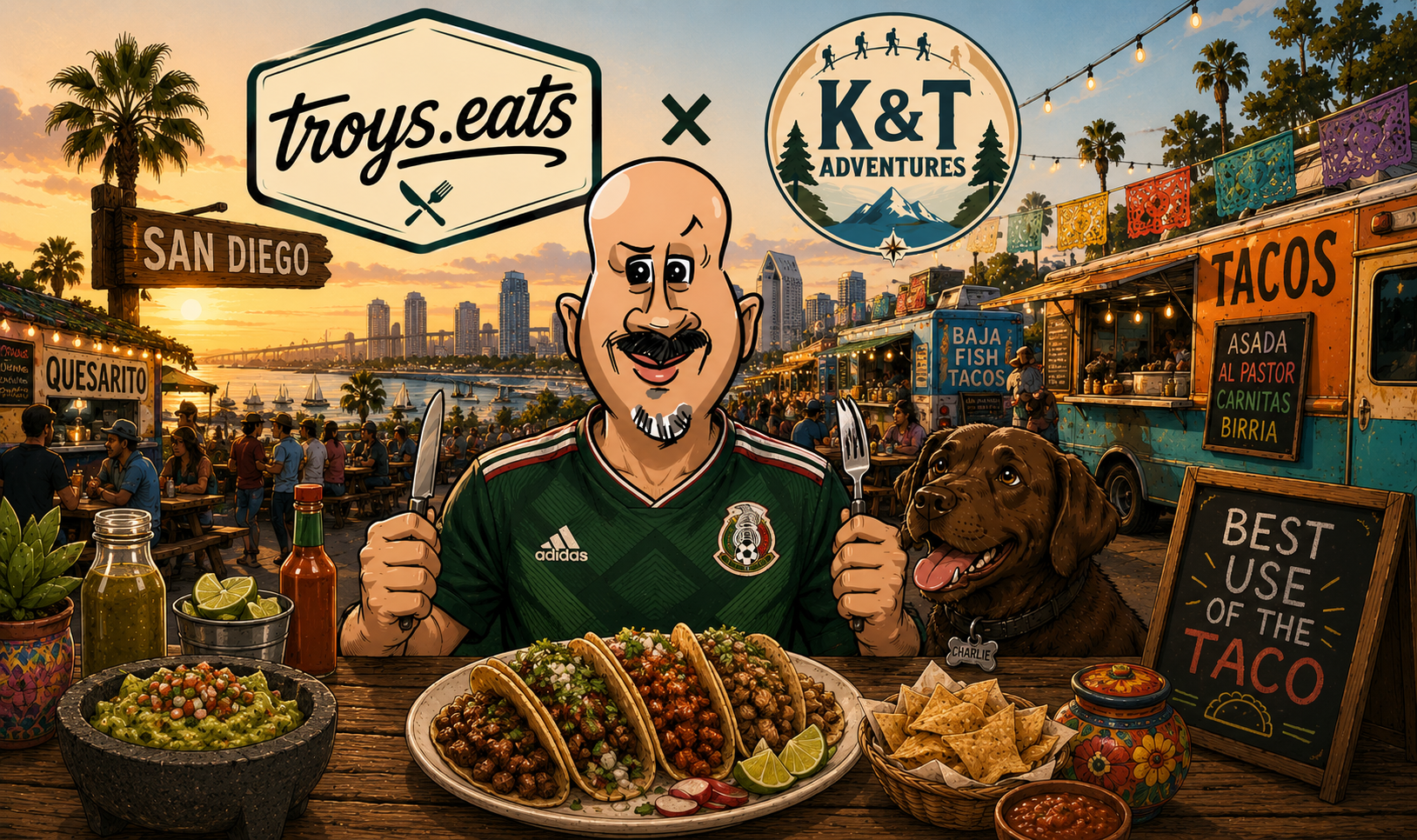
San Diego sits at the edge of one of the greatest food cultures in the world. Cross the border — or just drive south — and you find a Mexican food tradition that San Diego has been absorbing, adapting, and occasionally perfecting for generations. This series chases the real stuff: the tacos worth driving for, the spots where the salsa bar tells the whole story before you've taken a bite. Scored on a five-taco scale across Flavor, Customer Service, and Best Use of the Taco.
Start at the salsa bar. Seriously — before you order, before you even sit down, walk the whole length of it. Ten to twelve fresh salsas, each one distinct: sweet and smoky, bright and citrusy, deep red and quietly dangerous, a green that bites back just enough to remind you it's paying attention. One honest note: no pico de gallo in the lineup, which felt like a gap — a classic fresh tomato salsa would've rounded out the spread nicely. Still, this isn't a side attraction — it's the architecture the whole meal is built around, and it earns five tacos on its own. One more thing that deserves mention: the corn tortillas are made fresh in-house, and you can taste it. They have a warmth and a slight chew that the packaged stuff just can't fake — it quietly elevates every bite. Then the food itself: the shrimp taco is breaded, fried, warm, and generous in a way that makes one taco a complete argument for the concept — one will genuinely fill some people, a fact worth knowing before you order three. The chicken chipotle burrito is massive, fresh, crunchy in the right places, and lands exactly where you want lunch to land — satisfied, not regretting it, quietly thinking about going back. Everything out of this kitchen tastes like someone actually cared.
The vibe is food truck: efficient, friendly, zero pretension, zero fuss. The team is warm and genuinely kind, and they keep things moving without making you feel rushed through it. One honest note: my Spanish wasn't keeping up with theirs, and there were a few moments where I felt the gap — not in an unwelcoming way, more like a gentle reminder that I was a guest in their house and probably should have brushed up before walking in. The four tacos here reflect service that was genuinely good; the missing one is on me more than them.
Here's the honest version: I wasn't expecting fried, breaded shrimp inside a taco at a spot like this. I'd built a picture in my head of something more traditional, and when the plate arrived it took me a beat to recalibrate. Once I did — once I actually tasted it instead of comparing it to what I'd imagined — it worked. The shrimp pairs brilliantly with the salsa bar, which is really the secret weapon of the whole operation. The 3.5 isn't a knock on the taco. It's an honest score from someone who came in with an assumption and left with a full stomach and a revised opinion. Lesson learned: read the menu before you order, and let the salsa bar guide you the rest of the way.
If you've got a San Diego Mexican food recommendation worth reviewing, send it my way. Every submission goes straight to my inbox — I'll check it out and if it makes the cut, it earns a full troy's.eats review.